Guide · Updated · By Buğra Sözeri
Digital Signature vs. Electronic Signature
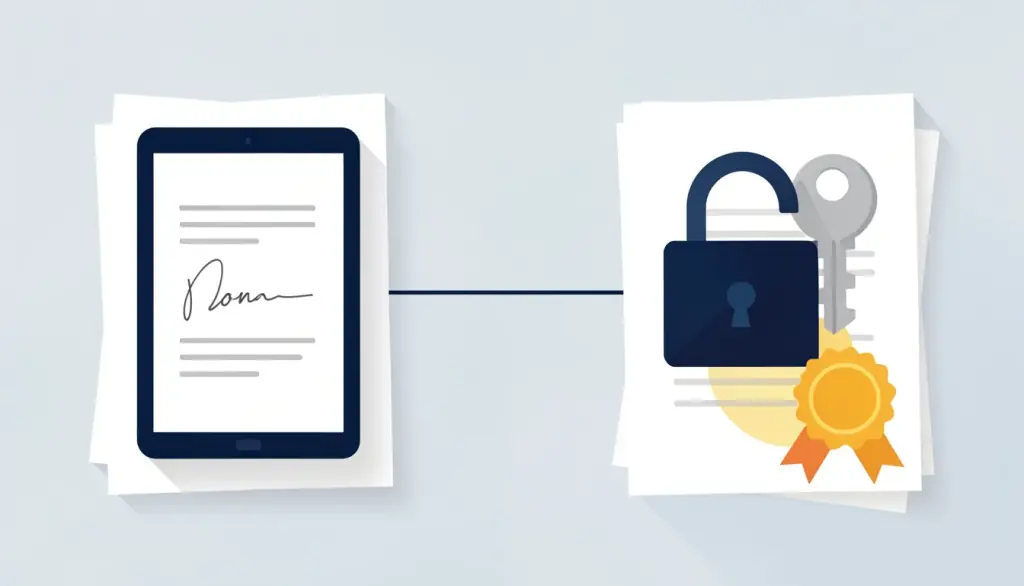
The terms are often used interchangeably, but they are not the same. An electronic signature is any electronic sign of intent to sign. A digital signature is a specific technical method that uses certificates and cryptography.
What is an electronic signature?
An electronic signature is a broad legal concept: a typed name, a drawn signature, a click on an "I agree" button, or a signature added through an e-signature service. Laws such as the US ESIGN Act and UETA, and the EU's eIDAS Regulation, recognize electronic signatures for most transactions.
What is a digital signature?
A digital signature uses public-key cryptography. The signer's certificate is linked to the document so that any later change to the file can be detected, and the certificate identifies the signer.
Under eIDAS, advanced and qualified electronic signatures usually rely on this kind of technology. A qualified electronic signature has the same legal effect as a handwritten signature across the EU.
Which one do you need?
For most everyday business documents, such as NDAs, freelance contracts and many leases, a standard electronic signature with a good audit trail is common practice. Some documents or jurisdictions require an advanced or qualified signature, or exclude electronic signatures entirely.
eSignSimple provides simple electronic signatures: free in-browser Sign PDF and Fill PDF tools with every account, and sending PDF or Word documents for signature with an audit trail. It does not currently offer qualified electronic signatures.
Side by side: how do they compare?
Identity: a simple electronic signature is tied to a person through evidence such as the email address the link was sent to; a digital signature ties it to a certificate issued to that person. Tamper detection: an e-signature service can fingerprint the final file with a hash such as SHA-256 so changes are detectable; a digital signature embeds that protection in the PDF itself. Cost and friction: simple signatures need nothing from the signer; certificate-based ones usually need an identity check and a digital ID.
Under eIDAS, the ladder is simple, advanced and qualified. Our EU legality page explains when each level matters.
How do you check which kind you received?
Open the PDF in Acrobat Reader. A certificate-based signature shows up in the signature panel with a validation status. A simple e-signature appears as a mark on the page, and the evidence is in the certificate of completion and audit trail. Our guide on how to verify an electronic signature walks through both.
Why do people say digital signature when they mean e-signature?
Mostly habit and marketing. In everyday speech, anything signed on a screen gets called a digital signature, and some software uses the phrase for drawn signatures as well. Adobe adds to the confusion by calling the certificate you sign with a digital ID, while its Fill & Sign feature produces an ordinary image-based mark. When a contract, a client or a government form asks for a digital signature, it is worth one short question back: do they mean a certificate-based signature, or just a signature that is not on paper?
The answer changes what you need to do. If they mean any electronic signature, a typed or drawn signature through a service with an audit trail is fine. If they mean a certificate-based or qualified signature, you will need a digital ID from a certificate provider, and usually an identity check before it is issued. Asking first saves you from buying a certificate nobody required, or from sending a simple signature to someone who will reject it.
Worked example: three documents, three different answers
A design studio hires a freelance illustrator and both sign a two-page NDA and a freelance contract. Nothing in the law of most countries asks for more than intent to sign and a reliable record, so a simple electronic signature sent to each person's email is the normal choice. It takes both sides a couple of minutes, and the certificate of completion shows who signed and when.
The same studio then bids for a public contract in an EU member state. Tender portals there often ask for an advanced or qualified signature on the bid documents, because the authority wants a signer identity checked by a trust service provider. Here a simple signature may be rejected on technical grounds, regardless of how strong the audit trail is. The fix is to get a qualified certificate from a provider listed for that country well before the deadline, since identity checks can take days.
Finally, one of the founders buys an apartment. Property transfers in many countries still go through a notary or a land registry with its own signing rules, and neither kind of e-signature from an ordinary service replaces that. The lesson: the document and the jurisdiction decide the signature type, not the technology you happen to have.
What does a certificate-based signature involve for the signer?
Before you can create one, a certificate authority or trust service provider has to issue you a certificate, which usually means proving your identity with a passport or national ID, sometimes on a video call or in person. The certificate then lives on a smart card, a USB token, or increasingly in a remote signing service where you confirm each signature with a one-time code. Certificates expire, often after one to three years, and have to be renewed.
For the person receiving the document, validation depends on their PDF reader trusting the chain of certificates. That is why a perfectly valid signature can show a warning in Acrobat on one computer and a green tick on another. Long-lived documents also raise a question simple signatures avoid: what happens when the signing certificate expires years later? Providers deal with this through trusted timestamps and long-term validation data embedded in the PDF. None of this is a reason to avoid digital signatures when you need them, but it explains why they cost more and add friction.
Common misunderstandings to avoid
A signature image pasted into a PDF is not a digital signature, even if it was created with a tablet and a stylus. A certificate-based signature does not prove the signer read the document; it proves which key signed which bytes. And outside the EU and a few countries with similar tiered laws, there is often no legal category called qualified at all: US law under the ESIGN Act is technology-neutral and treats simple and certificate-based signatures the same way in principle, leaving the weight of the evidence to be argued if there is a dispute.
The last common mistake is assuming a higher level is always better. A qualified signature on a routine sales quote adds cost and delay and gives the other side a reason to put off signing. Match the level to the requirement, and keep the evidence for everything else. Our legality pages list where the stricter levels are required, and are electronic signatures legally binding covers the general rules.
Our take
Vendors blur these terms on purpose, because "digital signature" sounds more secure and justifies a higher price. For a freelance contract, an NDA or a lease in most places, you do not need a certificate-based signature; you need clear intent, a fixed document and a good record. Pay for qualified signatures when a law or a counterparty actually requires them, not because the word "digital" sounds safer.
Sources and further reading
Frequently asked questions
Is a digital signature more secure?
Certificate-based digital signatures make tampering detectable and tie the signature to a verified identity, which gives stronger evidence than a simple image.
Is an electronic signature legally binding?
In most countries, yes, for most documents. See our guide on whether electronic signatures are legally binding.
What is an audit trail?
A record of events such as when a document was sent, viewed and signed. It helps prove how and when a document was signed.
Do I need a digital certificate to sign a PDF?
Not for a standard electronic signature. Certificates are only needed for certificate-based digital signatures.
Is a digital ID the same as a digital signature?
No. A digital ID is the certificate and private key that belong to you. A digital signature is what you create with it each time you sign a document.
Does the United States have qualified electronic signatures?
Not as a legal category. US law under the ESIGN Act and UETA is technology-neutral, so it does not rank signature types the way the EU's eIDAS Regulation does.
Can one PDF contain both kinds of signature?
Yes. A document can carry simple signatures from some signers and certificate-based signatures from others. Each certificate-based signature is validated separately in the PDF reader.
Get your next document signed today.
Start with 3 free documents a month. No card needed.